


By Catherine de Hueck Doherty, My Russian Yesterdays, Madonna House Publications, used with permission
Catherine was brought up in Russia and had many fond memories of her life there….a life that reflected simplicity, family, religion. After fleeing Russia during the Communist Revolution, she eventually came into the Catholic Church. Catherine prayed much that her motherland would be freed from Communist rule so that people could once again openly practice their faith.
❀❀❀❀❀❀❀❀❀❀❀❀❀❀❀❀❀❀❀❀
Customs within the family, especially the religious ones, are what keep the children grounded. It is part of who they are within the context of the family, as well as their community and the Church. They will pass this legacy onto their own children. The time we spend on them is always worthwhile…more than we know.
❀❀❀❀❀❀❀❀❀❀❀❀❀❀❀❀❀❀❀❀
Customs
Customs … where did they originate? Why did they integrate themselves into the lives of this nation or that? Why do they cling so tenaciously to one’s heart and mind? Why do they form part of one’s own substance, set one apart from all other people and nations, and put on one their seal of “belonging”?
Perhaps somewhere, someone has answered these questions, but I have not as yet come across the answers. All I know is that the ways and customs of my people cling to me wherever I go. Almost unconsciously I follow them, patterning my life according to their familiar designs.
Some of them, I know, stem from religious observances, Christian or pagan; others just do not seem to have any beginnings that I know of. But all have a hold on me that, I suppose, death alone will break.
I am glad of it, for they make my life fuller and richer, and somehow bring home to me the brotherhood of men under the Fatherhood of God.
For into my new adopted country, I bring the old folk-ways of my people, sharing them with my new brothers and sisters in Canada and the United States. They, in turn, teach me their customs and ways.
We get to know each other better, in a more intimate way, love each other more, and understand each other more easily, all of which goes to bring us closer together. And that is good.
Take traveling, for instance. Would anyone in old Russia venture on a journey without a supply of holy water? Of course, I have spoken before this of the love and veneration my people have for the sacramentals of the Church, but it bears repeating. For it seems that Catholics today have forgotten the powerful help in these.
It is a pity they are relegated today to convents and monasteries only. Perhaps the old Russians have something to teach us here. For most assuredly, in the old days, no one would undertake any journey without holy water.
We had a strange real understanding – a special grace of God, indubitably – of the prince of evil and his dangerous ways. Both were close to us, and we guarded against them assiduously. That is why the family sat all together before undertaking the journey and prayed.
A Hail Mary to Our Lady of the Travelers – an invocation for help to St. Raphael, and to the Angel Guardian – one was not afraid then of anything, for surely this was good company to have on the journey. We made sure they shared the journey with us. Even when we were to go alone, we first sat and prayed.
Would anyone in old Russia live in an unblessed house or apartment? Not likely. For it would be empty, a desolate place, where sorrow, pain, and sickness would come to dwell. People living there would be without the strength of Faith, Hope, and Charity (not to mention the immense benefits and graces that come with a priestly blessing). How could they carry the cross joyfully?
Who, in any Russian village, in the length and breadth of the whole land, would dare to plow and harrow an unblessed field? Or seed it with unblessed grain? No one but an infidel.
And the feast days! So many of them are marked forever in my heart with ways and customs that made them both holy and happy. A joy forever!
St. John the Baptist’s Day, for illustration, was celebrated with huge bonfires. They seemed to reach the very skies, and they always brought out daring young men who jumped through dancing flames. Strangely enough they all came out unscathed and untouched by those fiery and dangerous fingers! Probably each whispered a quick prayer to the fearless saint.
On the same day the girls would weave beautiful wreaths from the many field flowers that bloomed about that time of the year. Laden with them, they would go to the nearest river or lake and, taking careful aim, throw them into the water to the accompaniment of age-old verses whose origin was lost in the dimness of centuries gone by.
These rhymes expressed their hopes and desires. This rite performed, the girls would run along the banks, a colorful and beautiful crowd, dressed in their native costumes. Each would watch her own wreath breathlessly, for the wreath that kept afloat longest promised its owner marriage within a year. And where is the young heart that does not yearn for love and romance?
The great feast of the Most Holy Trinity was also called the Green Feast in my youth. Then the Church and many of the homes were decorated with freshly cut green boughs-the color of spring and hope, and of love, and of God which to us were synonymous.
But it was also the day of the birch. The village youth would gather at eventide and, with special songs and much laughter, go in search of the nearest and prettiest birch tree. The girls then, with the help of the boys, would decorate it with multicolored ribbons and flowers. The task accomplished, they would dance around it, special dances, to special old songs that have been taught from generation to generation.
The boys at certain intervals were allowed to take a ribbon off the tree and pair off with the girl it belonged to. Many a true romance started there and then. No wonder the birch is the national Russian tree.
Old and new were intimately and strangely interwoven in Russia. Anchorites. In the West they are but a name to be found in very old religious books or in new ones speaking of the early ages of the Church. Perhaps Russia was the only country that still had them in my youth; and I would not be at all surprised to learn that they are still there, living in the virgin woods that are even yet so plentiful in that immense land.
Though they are not exactly a “custom” of my people, they are part of its national life. For these solitaries, who left their monasteries with the permission of their abbots or other superiors, for one year or many, to dwell in solitude in the wild places, were much beloved by my people. And they expressed this veneration and love in thousands of ways.
No matter how far such a holy one might go to hide himself and dwell in prayer, fasting, and penance, the rumor of his presence would travel to the nearest village. From there, by word of mouth, it would go through the whole land. And there would always be someone to bring him food and drink … Then later the sick were brought to him. And the sorrowful would seek him out, for advice, blessing, and consolation.
I saw one myself once, just after his return to the monastery of his origin. He had come back at the bidding of his superior. He was thin to the point of emaciation. His face was literally transparent; and through it shone a guiltless soul, a radiance. He was as one set apart, glowing with humility, gentleness, and the love of God and man.
As I knelt at his feet for his blessing, I felt healed, renewed, and joyful in the Lord. No wonder people loved and cherished the lonely ones so. No wonder, too, that their presence was considered, and indeed was, a blessing!
Thus it seemed that no matter where one turned, in Russia, there was a blessing of God to be found. Houses, fields, cattle, bees, forests, waters, fruits, harvests, vehicles, machinery, children, women, men, food-all reflected the blessing of God, His Church, and His priests. Added to all this was the blessing of the presence of the silent anchorites, who kept alive, under obedience, the penitent ways of the early Church.
Speaking of blessings, I wonder if my Catholic friends realize the blessing of a vigil light? I have mentioned them several times through this book, because they still “bless” every place I ever lived in. There is something about their flickering soft light, burning steadily before a favorite statue or ikon, that makes any room or any house, be it ever so humble or ever so magnificent, truly “blessed.” Perhaps this is because the light so constantly and so faithfully reminds one of God and the things of God. Or maybe it is because we left it there as a more constant prayer than we ourselves could give, who are so busy.
Be it as it may, the loved and constantly present vigil light that always burned in Russian homes, and still does in mine, brought-and still brings-God and Our Lady closer, makes one feel secure and at peace. Yes, it is good to have them around.
It is good, too, to have special foods for special feasts and special days. I have spoken much of them already, but I would like to go on talking about them. For they are accents that make a certain day stand out, separate and vivid, apart from other days. That is why, again, wherever I am, I cook them.
I often go to great lengths to get together the proper ingredients for these special dishes. Hard or easy, they eventually grace my humble board on the appointed day, to the delight of friends and strangers, especially when their significance, spiritual or historical, is made clear.
For in God all things come together-if properly used-to render glory to Him who is the Author of them. And what education, what fun and joy, these old ways and customs of my people were for the children and young ones! How easily they learned through them to love and serve God better!
Even if certain customs were not exactly connected with Christianity, they made history live for many of the young.
May our Blessed Lady, whose shrines form so beautiful a rosary around the land of my forefathers, bring Russia back to her Father’s house, and give back to her people the right to enjoy the old, holy, and joyous ways of their ancestors that made every year a new adventure in living and being. Amen.



“Painful trials strengthen our faith and make it purer, more supernatural; the soul believes, not because of the consolation that faith gives it, not because it trusts in its feelings or enthusiasm, not even in the little it does understand of the divine mysteries, but it believes only because God has spoken. When the Lord wishes to lead souls to a more intimate union with Himself, He almost always makes them undergo such trials; then is the moment to give Him testimony of our faith by throwing ourselves, with our eyes closed, into His arms.” – Divine Intimacy


Do not let feelings govern you. Feeling is a force God gives you for willing and working with greater energy and constancy. But like steam in a locomotive it is a chaotic force. If well channeled by reason (with its safety valves and opportune expansion and release) it will be exceedingly useful to you….


Anna’s Blossoms of Joy~Catholic Hearth Story! Catholic Children’s Easter/Spring Book Set in Poetic Rhyme~Beautiful Hand-Drawn Illustrations ~ Available here.


6 Catholic Hearth Stories! Will You Be My Friend,Joseph Bow Shoot,Two Tea Parties,Brendan Seafarer,Celine’s Advent,Anna’s Blossoms of Joy! Catholic Hearth Stories are tales filled with traditional, old-fashioned values. They are about everyday situations in the life of a Catholic family…Tales about home, friends, fun, sacrifice, prayer, etc. These are full-color books sure to capture the heart of your children….Available here.


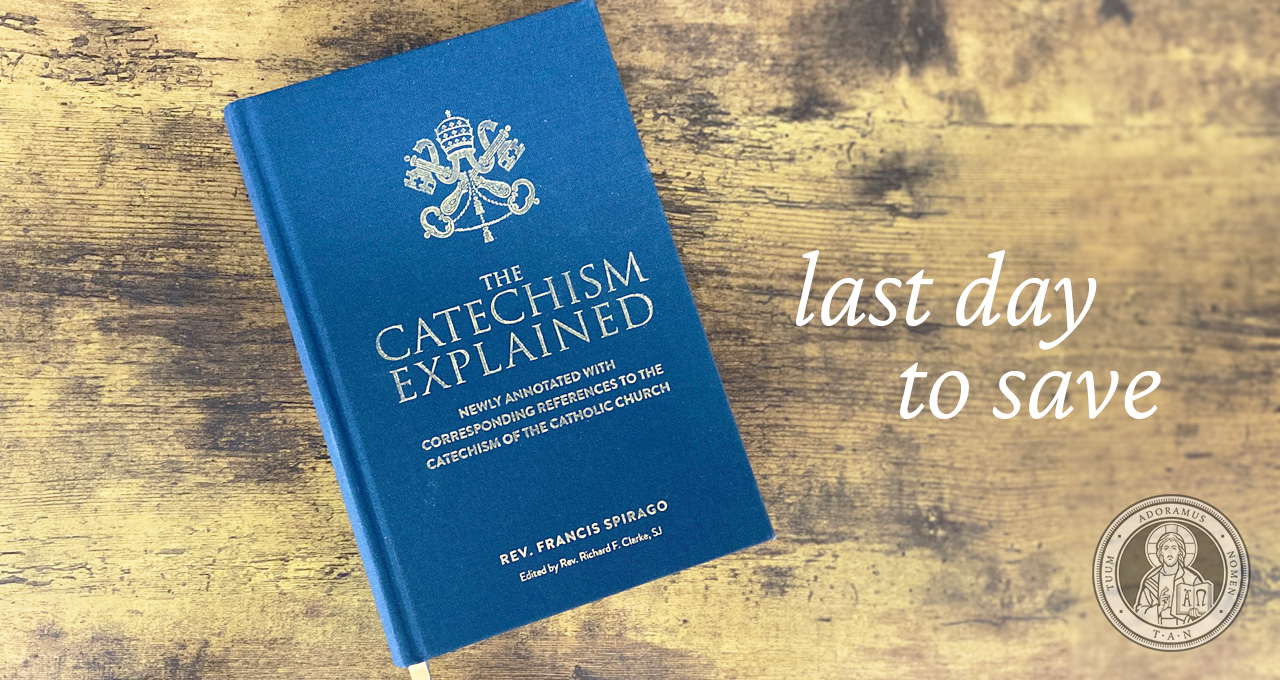
Last Day! $35 ~ The Catechism Explained ~ Available here.
Today is the last day to receive The Catechism Explained for just $35!
There is nothing more important than the application of the Faith in our daily lives. But many Catholics find their knowledge of Church doctrine and tradition lacking. The Catechism Explained is a great resource for all Catholics to deepen their Faith and their knowledge of it.
Just as the disciples of Jesus were instructed in the Faith before they were sent out, so too must we be instructed before we can bring the Faith to others.
Don’t miss out on this opportunity! Get your copy of the book all Catholics should have in their library!
Books on St. Catherine of Sienna ~ Available here.
As the month of April draws to a close, we celebrate the feast day of one of the Church’s most beloved saints: Saint Catherine of Siena. This great saint with her formidable Faith, reached spiritual heights that we all ought to strive for. By her immeasurable love for God, this spiritual giant shook the souls of all who encountered her.
For us still striving toward holiness, the witness of Saint Catherine is a blessing beyond measure. She teaches us to give all to God and to find holiness in the vocation He calls us to. She is a reminder of our duty to defend the Faith and to live out our Christian lives with great zeal.
Let us call upon Saint Catherine of Siena to teach us true faithfulness to God. May she help us to “be who God meant us to be” so that, like her, we too may “set the world afire.”

This post contains affiliate links. Thank you for your support.







To bring holy water with you, that is one I had not heard before, but I like it!
This lady writes so beautifully!