


Thoughts from Fr. Lovasik, Fr. Daniel A. Lord, Fr. George Kelly and Alice von Hildebrand
There are many books written about how to have a happy marriage. There are conferences, counselors, lists of rules, and all sorts of advice about communication. But perhaps one of the greatest marriage counsels ever given is also one of the simplest:
“As you would that men should do to you, do you also to them in like manner.”
—Luke 6:31
Or, as we learned it when we were children: Do unto others as you would have them do unto you.
I remember listening to a marriage podcast and this husband, he is a Catholic, pointed out two important things to get right in marriage. This never left me:
✨Get enough sleep (Don’t bring up hard things when you or he is tired)
And…
✨The Golden Rule: Do unto others…
We teach this to our children. We remind them to share, to speak kindly, to think of the other person, to apologize when they have hurt someone. And yet how easy it is to forget that the person to whom we should practice this rule most faithfully is the person with whom we live every day.
Our husband. Our wife.
The Person Closest to Us
There is something rather peculiar about human nature. We can be wonderfully patient with acquaintances and remarkably impatient with those we love.
We wouldn’t dream of snapping at the woman behind us in the grocery store because she asked us to repeat ourselves. Yet our spouse asks, “What did you say?” and we may answer with an irritated sigh.
We thank the waitress who brings us a cup of coffee. Do we thank our spouse for the hundreds of ordinary things he or she does?
We overlook the irritating habits of friends because, after all, nobody is perfect. Do we extend the same generosity to the person we married?
Perhaps this is where the Golden Rule becomes very practical.
How would I want to be treated if I had made that mistake? How would I want to be spoken to if I were tired? How would I want my faults corrected? How would I want to be treated after a bad day?
Would I want every careless word I had spoken remembered and brought up again six months later? Would I want my good qualities noticed as readily as my faults?
Those little questions can change the atmosphere of a home.
Marriage Is Made Up of Little Things
We sometimes imagine that great love proves itself in great sacrifices. Certainly it does. But most married couples aren’t asked to make heroic sacrifices every morning before breakfast. They are asked to make very small ones.
Alice von Hildebrand wrote beautifully about this. She told of something that bothered her early in her marriage: her husband left the soap sitting in water. She mentioned it to him, and from then on he made the effort to dry it after using it.
A ridiculously small thing? Perhaps.
But she remembered that little gesture of love for years. Why?
Because the message behind it was:
This matters to you, and therefore it matters to me. That is love. We can become so concerned about whether our spouse is meeting our needs that we forget to ask a much more fruitful question:
What can I do today that would make his or her life a little happier?
Put the toothpaste cap on. Pick up the pajamas. Make the cup of coffee. Listen to the story even though you’ve heard part of it before. Say thank you. Smile when he comes through the door. Put down the phone when he is talking. Do the little job you know annoys him when it is left undone.
None of these things sounds very romantic. But after twenty, thirty, forty or fifty years, a marriage is largely made out of such things.
Don’t Keep Score
One of the quickest ways to become unhappy in marriage is to begin keeping accounts.
I did this, so he should do that. I gave in last time. She never notices what I do. Why should I make the first move?
Once we begin keeping score, even acts of kindness can become transactions.
Christian marriage calls us to something better. Sometimes we give because we love. Sometimes we give because the other person is tired. Sometimes we give because this particular thing matters much more to our spouse than it does to us. And sometimes we give simply because Our Lord has given us an opportunity to conquer ourselves.
Marriage cannot always be fifty-fifty.
There will be days when it is eighty-twenty. There may be seasons when one spouse carries much more of the burden because the other is sick, discouraged, overwhelmed or simply struggling.
The important thing is that husband and wife remember that they are not competitors. They are on the same side.
Learn How to Disagree Without Becoming Enemies
A happy marriage is not a marriage without disagreements. mTwo people come from different families, different temperaments and different experiences. Of course they will sometimes see things differently. The important question is not, Will we disagree?
It is, How will we treat one another when we disagree?
Once again, the Golden Rule provides a remarkably good answer.
Would you like to be mocked when you are trying to explain yourself? Then don’t mock.
Would you like your past mistakes dragged into every disagreement? Then don’t drag up the past.
Would you like to be called names? Then don’t call names.
Would you like your spouse to listen long enough to understand what you are actually saying? Then listen.
Would you like a chance to calm down before continuing a difficult conversation? Give the same courtesy.
And when the disagreement is over, let it be over.
There is a great difference between discussing a problem and attacking a person. A husband and wife can disagree and still be affectionate. They can even disagree strongly while remembering, This is the person I love.
Give In Sometimes
This may be one of the least fashionable pieces of marriage advice.
Give in.
Not in matters of Faith or morals, of course. And certainly Christian charity does not mean tolerating serious abuse or wrongdoing. But how many marital battles really concern great principles?
Which restaurant? Where to put something? How much to spend on a nonessential item? Whose family to visit first? What movie to watch? Whether the window should be open or closed?
Sometimes peace is worth far more than getting our own way.
Father Lovasik reminds married couples that selfishness continually insists upon its own desires, while genuine love requires sacrifice, compromise and understanding.
There is great freedom in occasionally saying cheerfully: “All right. We’ll do it your way.” And then—this is important—do not spend the rest of the evening making the other person sorry you agreed!
Give graciously.
Forgive Quickly
If we want our spouse to forgive our faults, we must be willing to forgive his.
This is the Golden Rule again. There are no marriages between perfect people.
We will say things badly. We will misunderstand. We will be selfish. We will have headaches, bad moods and exhausting days. Sometimes we will realize immediately that we behaved badly. Sometimes it may take a little longer.
But resentment is terribly expensive. It takes yesterday’s unhappiness and makes us pay for it again today.
There is wisdom in settling things quickly. Apologize when you should apologize. Forgive when you should forgive.Three little words can save an astonishing amount of misery:
“I was wrong.” And three more: “I forgive you.”
Neither makes a person smaller. Both make a marriage stronger.
Assume the Best
There is another habit that can quietly transform marriage: give your spouse the benefit of the doubt. If we are already irritated, we can attach the worst possible interpretation to almost anything.
He didn’t notice. He doesn’t care. He did that on purpose. He knows I hate that.
But what if he simply forgot? What if he is tired? What if there was no hidden meaning at all?
We are usually generous when interpreting our own behavior. We know all the extenuating circumstances!
“I didn’t mean it that way.”
“I was exhausted.”
“I forgot.”
“I’ve had so much on my mind.”
Perhaps we should extend that same generosity to our spouse. After all, isn’t that how we would like to be treated?
Notice the Good
After many years of marriage, it is terribly easy to take the good things for granted.
The faithful husband who gets up and goes to work. The repaired faucet. The errands. The bills paid. The hand reached across the car. The familiar laugh. The cup of coffee made just the way you like it.
The person who has stood beside you through births and deaths, sickness and health, financial worries, family problems, happy Christmases, ordinary Tuesdays and all the changing seasons of life.
Notice these things. Say them out loud.
“Thank you.” “I appreciate you.” “I’m glad I married you.”
We often think loving thoughts that we never bother to say. Say them.
Treat Your Spouse as You Would Like to Be Treated
Perhaps before looking for complicated solutions to marital unhappiness, husband and wife could begin with one very simple examination of conscience:
Am I treating my spouse the way I wish my spouse would treat me?
If I want tenderness, am I tender? If I want appreciation, do I show appreciation? If I want patience, am I patient?
If I want my faults overlooked, do I overlook little faults? If I want affection, do I give affection? If I want to be listened to, do I listen? If I want forgiveness, do I forgive? If I want my spouse to make an effort to please me, do I make an effort to please my spouse?
We cannot control another person’s behavior. But we have tremendous control over what we bring into our marriage each day.
And kindness has a way of multiplying. A smile often produces another smile. Appreciation makes a person want to do more. Gentleness softens defensiveness. Thoughtfulness awakens thoughtfulness.
Not always immediately, of course. Marriage is not a vending machine into which we insert kindness and demand an instant return. We love because love is good. We practice charity because it is pleasing to God. And over the years, all those little acts accumulate.
The Grace of the Sacrament
For Catholics, there is something more. Marriage is not merely two people attempting, through sheer determination, to tolerate one another for fifty years. It is a Sacrament.
Father Daniel A. Lord beautifully reminded married couples that St. Paul compared the union of husband and wife with the union of Christ and His Church. That raises everyday married love to something very beautiful indeed.
The patience required when your spouse irritates you, the forgiveness after an argument, the sacrifice of your preference, the meal prepared when you are tired, the affectionate word when you don’t particularly feel affectionate—these ordinary things can become acts of supernatural charity.
And perhaps that is one of the loveliest things about marriage.
God gives husband and wife countless opportunities to help one another become saints without ever leaving their own home.
Most of those opportunities won’t look very important.
They will look like a cup of coffee. A patient answer. A closed toothpaste tube. An apology. A kiss goodnight. A decision to overlook something. A prayer whispered for your spouse.
And a thousand quiet choices to live those simple words of Our Lord:
“As you would that men should do to you, do you also to them in like manner.”
It is a simple rule.
But lived faithfully, day after day and year after year, it can make a very happy marriage.
A note: this post was shaped with AI assistance from content already on Finer Femininity.


The truly religious wife finds God at Mass and from Him receives the strength to become the ideal helpmate to her husband. She does not leave God at church but keeps Him with her every minute of the day in every nook and cranny of her home. Each menial, repetitious task she must perform is a work of love for her husband and children, and through them, a work of love for her Creator. – Fr. Raoul Plus, S.J. 1950’s, The Wife Desired


My new Traditional Catholic Planner is now available for PREORDER!  Available here.

 Traditional Catholic Planner — Use Any Year
 A full year of planning
 Saint of the Day & Catholic inspiration
 Created with Catholic homemakers and families in mind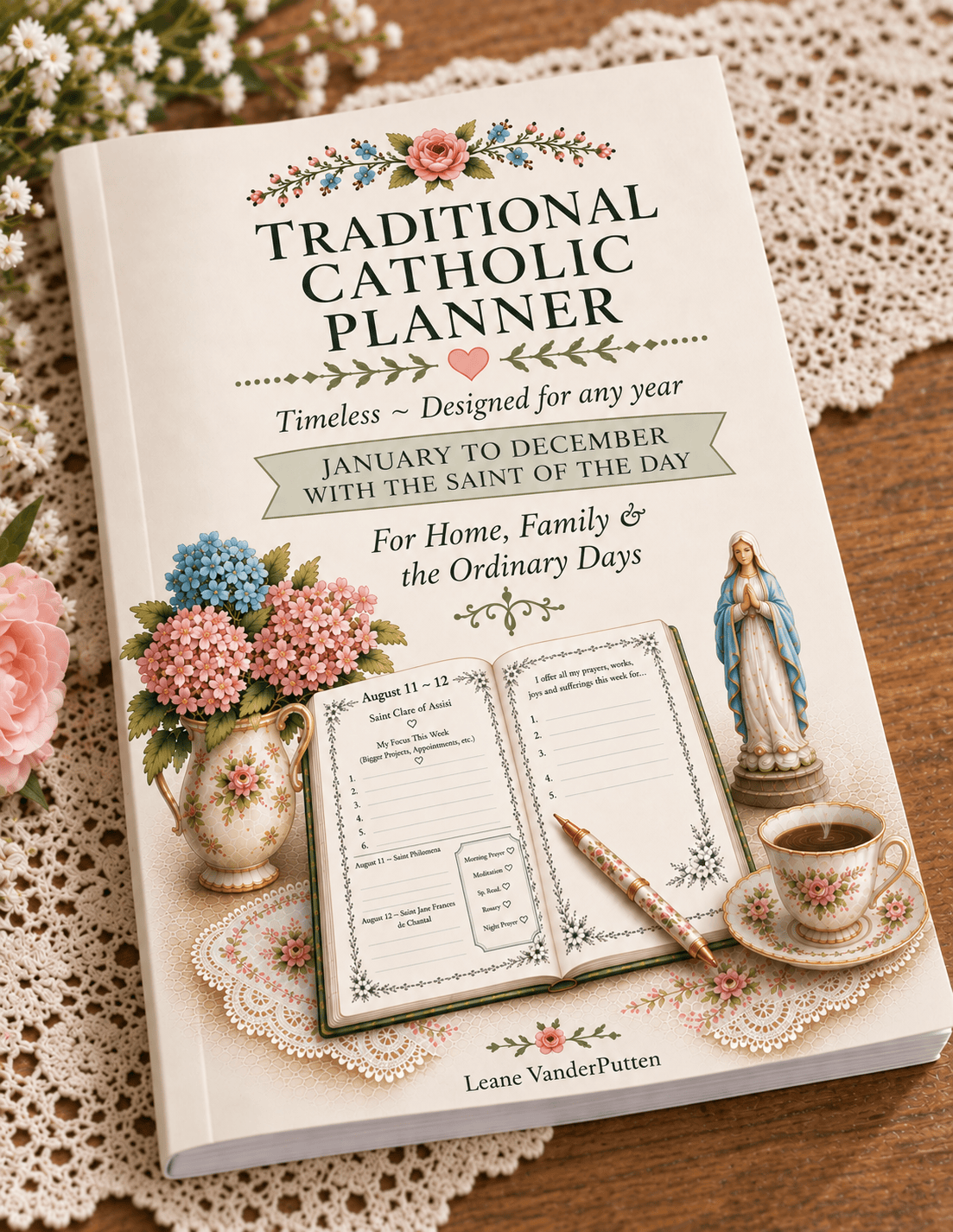


Beautiful St. Joseph Wire Wrapped Rosary! Lovely, Durable. Each link is handmade and wrapped around itself to ensure quality. Available here.


Beautiful Blessed Mother Wire Wrapped Rosary! Lovely, Durable. Each link is handmade and wrapped around itself to ensure quality. Available here.


NEW!
Play & Pray Little Catholic Reader is a beautifully illustrated beginning reader created especially for children ages 4–8. Filled with simple, faith-filled stories, it helps little ones build reading confidence while growing in their love for God.
Available here.
Bundle with Teacher Guide available here.


ON SALE AT TAN BOOKS!
The Life of St. Joseph as Seen by the Mystics ~ Available here.
Drawing from the visions of Saint Bridget of Sweden, Servant of God Marina de Escobar, Venerable Mary of Ágreda, Venerable Maria Cecilia Baij, and Blessed Anne Catherine Emmerich, this work presents a devotional narrative that fills in many of the hidden moments of Saint Joseph’s life. From his childhood and preparation for his divine mission to his peaceful death in the presence of Jesus and Mary, readers encounter a saint whose humility, courage, and fidelity shine on every page.

Abandonment to Divine Providence Deluxe Edition ~ Available here.
“Let go and let God.” This familiar phrase captures the heart of Abandonment to Divine Providence, Fr. Jean-Pierre de Caussade’s enduring spiritual classic on trust, surrender, and peace of soul. In a world marked by anxiety and constant striving, de Caussade offers a liberating truth: sanctity is found not in extraordinary experiences, but in faithful surrender to God’s will in the “sacrament of the present moment.” Whether you are burdened by suffering, tempted by doubt, or longing for greater interior stillness, this work shows how to entrust every trial and duty to divine grace. This Deluxe Edition honors the wisdom of this masterpiece with a premium presentation designed for a lifetime of spiritual growth.

This post contains affiliate links. Thank you for your support.







Thank you for this beautiful reflection on The Golden Rule in Marriage. May I have your permission to reprint for the members in my Catholic marriage prayer group?
Yes that is fine!