

From the book How to Raise Good Catholic Children by Mary Reed Newland
Explain the symbolism of the baptismal rite
Learning about Baptism can really be fun when it’s a feature of the preparation for a real Baptism, or the celebration of a baptismal feast. Celebrating the birthday of St. John the Baptist on June 24 is a good time for learning about Baptism.
A group of children sitting around the kitchen table while their mother mixes a feast-day cake will listen far more attentively to her talk about Baptism than the same group sitting around the dining-room table, catechisms in hand — especially if there’s a bowl to lick afterward.
We ought to invite more people to attend our babies’ Baptisms — that is, the sacrament part (which no one seems to want to attend) instead of the party (which can’t always accommodate all the people who think they should attend). And we ought all to celebrate our baptismal feasts with as much enthusiasm as we celebrate our birthdays. After all, this is the day, for the Christian: the day he’s born again in Christ.
Moreover, learning about Baptism in connection with all these occasions means learning more than the catechism teaches.
It’s a lovely custom for the family to provide their own baptismal garment and candle for a baby’s Baptism. White garments can be bought ready-made and embroidered with liturgical symbols, or can be made and embroidered at home. Sometimes they’re like a bib or sacque or, as in our family, a piece of fine linen cloth can be used for each child.
This is embroidered with the symbols of each sacrament as the child receives them, and parts of it are appliquéd to a First Communion dress, a Confirmation dress, and a wedding dress; or it can be made into a pocket handkerchief to carry at a boy’s First Communion, Confirmation, wedding, or even as an amice at Ordination.
The candle used at a Baptism (two are used, but one is handed to the sponsors) must fit the candlesticks in the baptistry; hence, it’s usually more convenient to have a blessed candle of ordinary size, decorated either before or after with appropriate symbols and lettered with the child’s name and the date.
For baptismal feasts at home, there are large liturgical candles available at religious-supply stores. These can be taken to the church before Candlemas (February 2), when Father will be glad to bless them with the rest of the candles.
Decorating a baptismal candle isn’t difficult, even for people who can’t draw a straight line. Liturgical symbols are all over the place, in missals, prayer books, on the walls of churches, on altars and vestments, on religious greeting cards. If none is found to describe a child’s patron saint, it’s quite all right to invent them.
First, a thin coat of white shellac goes over each spot where a design will be painted. Use a cheap paintbrush (shellac is death to good paintbrushes), and remove the shellac from the brush with rubbing alcohol.
Next, the designs are drawn or traced on paper with a soft lead pencil, then reversed and transferred to the candle by rubbing. Be sure to plan the spacing of the designs to leave enough room near the bottom of the candle for the child’s name, date of birth, and date of Baptism.
Oil paint with a little turpentine for thinning and a small pointed brush are best for the designs. After the paint is dry, another coat of shellac over them will be protection against handling.
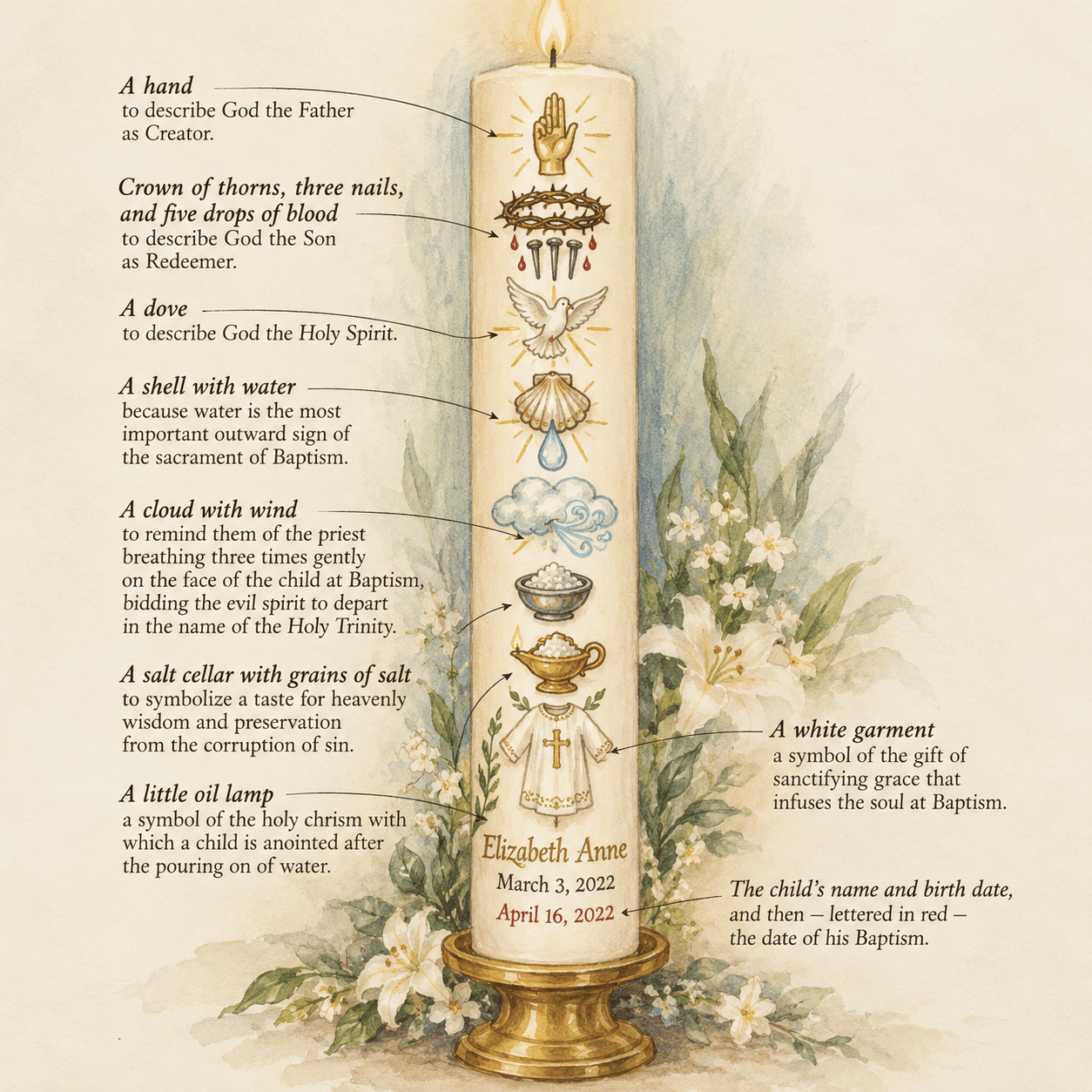
The first three symbols at the top of our candles (reading down) are for the Holy Trinity, to remind the children that their souls become the dwelling of the Trinity after Baptism. There are many symbols for each Person, but we have chosen those easiest for the children to remember.
A hand describes God the Father as Creator. The crown of thorns, three nails, and five drops of blood describe God the Son as Redeemer. A dove describes God the Holy Spirit.
Very little children must have it clearly explained that the Holy Spirit is not a dove. A dove has been seen at times as a sign of the Holy Spirit, but the Holy Spirit is really the love of the Father for the Son, and the love of the Son for the Father.
Next comes a shell with water, because water is the most important outward sign of the sacrament of Baptism.
Then we use a cloud with wind, to remind them of the priest breathing three times gently on the face of the child at Baptism, bidding the evil spirit to depart in the name of the Holy Trinity.46
Next, a salt cellar with grains of salt. This is the symbol children love best, because it’s so interesting to see a baby taste the salt at his Baptism, and because it’s symbolic of things they know in daily life.
At home we use salt to bring out the flavor of our food and to preserve such things as cucumbers (pickles), cabbage (sauerkraut), and fish (codfish cakes). In Baptism, a little blessed salt is put on the baby’s tongue as a pledge that it may have a taste for heavenly wisdom, and that it may be preserved from the corruption of sin.
It reminds us of the words of our Lord: “You are the salt of the earth. But if the salt lose its savor, wherewith shall it be salted? It is good for nothing anymore but to be cast out, and to be trodden on by men.”47
Then we add a little oil lamp, a symbol of the holy chrism with which a child is anointed after the pouring on of water. This is a sign that he’s now a member of Christ’s Mystical Body and has some share in the work of Christ’s Priesthood.
In this sense, he’s a lay priest. He may offer the Mass with the priest and Christ, as an act of adoration to the Father. A man and a woman administer the sacrament of Matrimony to one another, with the priest present as witness. In this, they act as lay priests.
Next, there’s the white garment. This is a symbol of the gift of sanctifying grace that infuses the soul at Baptism. In the early Church, the candidates for Baptism wore white garments, but more recently the priest has used a fine white napkin, napkin, laying it across the child’s head.
Last of all on the candle is the child’s name and birth date, and then — lettered in red — the date of his Baptism.
Celebrate Your Child’s Baptism Each Year
An English translation of the Rite of Baptism for Infants is needed if a child is to renew his baptismal vows at a baptismal feast. These leaflets cost very little and are available in religious-supply stores or from a number of publishers.
A brief rehearsal the day before helps the child to understand what each part means and what’s expected of him. On the evening of the feast, before the meal is served, the family stands around the table, and the father reads the questions asked of the sponsors when the child was too little to reply for himself, then gives the responses, which the child repeats after him.
The father does not imitate any of the things the priest did, but merely explains them, and for little children, it’s best to keep the explanation short and interesting rather than risk boredom with too many hard words or long prayers.
It starts with “N., what do you ask of the Church of God?”
“Faith.”
“What does faith bestow upon you?”
“Life everlasting.”
Then the father explains how the priest breathed upon the face of the child, signed him with the Cross upon the forehead and breast, laid his hand upon the head, and said a lovely prayer asking God to keep the child from sin and help him grow in perfection day by day.
Then he explains about the salt and the prayers of exorcism. Next comes the Apostles’ Creed, followed by the Our Father. Once too small to speak for himself, now the child can do it alone. It’s very moving to hear it.
Then the father explains how once more the priest commanded the Devil to depart and then, using the words of our Lord when he cured a man deaf and dumb, he touched the child’s ears saying, “Ephpheta, that is, be opened,” and touching his nostrils he said: “Unto the odor of sweetness. But thou, Devil, begone, for the judgment of God is at hand.”
Then come the “Do you renounce?” questions that children love to answer.
“N., do you renounce Satan?”
“I do renounce him.”
“And all his works?”
“I do renounce them.”
“And all his pomps?”
“I do renounce them.”
“But what does pomps mean?” someone will ask.
Pomp is defined as “a show of magnificence, display, brilliant splendor.” It’s easier to explain to grown-ups than to children.
It could apply to the way the Devil uses worldly displays to make us forget the holy meaning of the great Christian feasts, such as Christmas and Easter. It could apply to the way the splendor of impure movies or TV shows can blind us to the fact that they might arouse temptations in us and be occasions of sin.
Then the father explains how the child was anointed with the oil of catechumen on the breast and between the shoulders, and the priest changed his purple stole for a white one, to signify the joy of the Church receiving a prospective new member.
Next the “Do you believe?” questions, and then the priest asked the sponsors, for the child:
“N., do you wish to be baptized?”
And the sponsors answered for him, “I do.”
Then came the wonderful moment. Pouring water over his head, the priest said the words of Baptism, and the Holy Trinity came to make their home in the soul.
The bestowing of the three gifts came last of all. First, the anointing on the crown of the head with the sacred oil of priesthood to signify membership in Christ. Second, the presentation of the white garment to signify the gift of sanctifying grace.
Third, here the father hands the lighted baptismal candle to the child, saying as the priest did, “Receive this burning light and safeguard your baptism by a blameless life; keep God’s commandments so that when our Lord comes to the marriage feast, you may be worthy to greet Him with all the saints in the heavenly court, and live forever and ever.”
With, “Go in peace, and may the Lord be with you,” everyone kisses the child.
It’s a very proud moment, and seeing him there with his lighted candle, a symbol of the living Christ, whose life he shares, everyone feels the same — so glad to be baptized.


Peace of heart, a joyful spirit, love of neighbor, compassion for the sorrows of others, goodness of heart, patience, forbearance with others, a warm manner, acceptance of others’ desires that are not of offense to God: that is, to be gentle and lowly of heart. This is the character I propose to have and that I will continually ask of the Sacred Heart of Jesus and of Mary.
Venerable Bruno Lanteri (1759-1830)


Follow this link to sign up for the Giveaway!


New Book Publishing Store!
St. Bosco Books
I am excited about this new publishing company!
Our friend, Debbie Malain, has started a small Catholic book publishing company where she is bringing wonderful old Catholic novels back into print for children, youth, and adults.
I have always had a special love for old books—especially those beautiful Catholic stories from years gone by, filled with faith, virtue, adventure, and timeless lessons. So many of these treasures have become difficult to find, and I love the idea of making them available once again for today’s Catholic families.
Please take a peek! There may be an old treasure waiting to become a new favorite in your home. 

Great gift ideas for the kids! Please share!
❁✿❀❁✿❀❁✿❀❁✿❀❁✿❀❁✿❀
But Thy Love and Thy Grace ~ Available here.
A working-girl since she was eleven, Regina O’Connell has always been poor. Now she and her invalid sister are the only ones left of their family and live in tenement housing together. At the parish bazaar held to raise money for orphans, Regina enters the raffle for a diamond ring-the most beautiful ring she has ever seen; and her confessor, hearing her story from one of the women organizing the bazaar, puts Regina’s name on the chances he buys. God, however, is calling the young woman to a high degree of perfection, and at her confessor’s encouragement, she begins to generously pray the prayer of St. Ignatius, renouncing all the consolations of the world and asking for only God’s love and grace.
Available here.

Mary Rose Keeps House ~ Available here.
Returning from boarding school to her home in Friendville, sixteen-year-old Mary Rose is looking forward to a peaceful, relaxing summer. Her grandmother in Colorado falls ill, however, and Mary Rose’s mother has to go care for her, leaving Mary Rose in charge of her two younger siblings. Just before she leaves, Mother receives a letter from her brother, who informs her that his work is sending him to Japan, and he is entrusting his motherless children to her. Mary Rose’s four cousins are already en route to Friendville, and it is up to Mary Rose to take on the responsibility of caring for her “ready-made family” for the summer. Between parties and fun, illnesses, injuries, and a nearly-disastrous beach trip, Mary Rose experiences both the responsibilities and the joys of “growing up.”
Recommended for ages 10+, especially engaging to 12+







Awesome! My sweetie had insisted on the baptismal day celebration since our first born. And the kids as they have grown have all enjoyed it very much. But this reading gives me an idea for future ones, thank you! 😇
That’s wonderful to hear that you have been celebrating the baptisms!