


Artist: Jim Daly
From How to Raise Good Catholic Children by Mary Reed Newland
Help Your Child Develop a Right Attitude About Winning and Losing
When he’s playing games to win, or being sullen when he loses, is the time to help a child see the right end of play. “Be a good sport,” we call it. But how can you be a good sport if you don’t know what it means?
Competition is not so healthy as we like to think. It places far too much value on winning and exhibitionism, and underrates the degrees and varieties of gifts, the simple joy of participation. Worst of all, it’s such an accepted measure for all forms of activity that no amount of philosophizing will comfort great numbers of people who have discovered they’re only second bests.
We can help our children to enjoy play, even when it must take the form of competitive play, and to be “good sports,” if we try in the beginning to take the emphasis off competition and put in its place an awareness that success in anything for them is doing as well as they’re able to do. It has nothing to do with whether God has equipped someone else to do it better.
When a child has reached the limit of his ability, it’s time to rest, and if such happens to be the case, give honest praise for the talents of the winner. If prayer is play, too, then basketball in the backyard can be a prayer — but not if it’s spoiled by resentment.
Nor can play be any kind of prayer if it isn’t honest. Cheating doesn’t fool anyone, least of all God, and it belongs in the same category of sins as stealing and lying.
We must also help children to be honest about disappointment. “I don’t care” isn’t honest when one does care. “I did the best I could, but I wish I could have won,” is normal and honest; and until children learn to find their joy in effort alone, this attitude will help ease their disappointment.
They will find, too, that disappointment is temporary, not long-lived. Everyone tastes defeat and disappointment sooner or later; learning what to do with it in childhood is a great protection against bitterness in maturity. Disappointment, too, can be offered up as prayer.
Athletics Teach the Value of Teamwork
Children learn speed, grace, coordination, accuracy, and many things from athletic skills. We have to be careful, though, that they do not overestimate their capacity or their talent, and we can do them grave harm by encouraging feats obviously beyond their ability. This applies not only to athletic activities but to creative activity and vocational experiments as well.
Few children can get too much praise and encouragement, except when we delude them into believing that they possess talents they do not possess or goad them on to heights they can never attain.
Art schools, music schools, and dancing schools are full of students who are pursuing will-o’-the-wisps, whose parents have so overrated their natural gifts that instead of seeking the right end with their talents — how to use them to enrich a useful life — they become the means of gigantic frustrations.
Not all boys who are star pitchers on school teams are called by God to be professional ballplayers. But given no means of fitting such gifts into the whole purpose of life, they become ends in themselves, as a newly signed ballplayer put it recently: “A chance to make as much money as N. and marry a Hollywood star like N.” This is not the end of the talents of ballplayers, nor the purpose of sports.
The gifts are supposed to give glory to God, from whom they came. If we can teach children that this is the whole point of their play and the use of their talents, it might not be so difficult to keep sports where they belong instead of elevating them to the status of a national religion.
The point of games is to play them, not to watch them, and the purpose of athletics in schools is frustrated when the majority of youngsters watch a few burn off energies in sport while the majority must find an outlet for their energies somewhere else.
Fathers and sons watching televised games participate in only the most barren way in the real joy of sports. It’s much more to the point if the fathers turn off the TV set and get out and pitch balls to their sons.
Group play and school athletics are important not only because they are a means of expending youthful energy, but also because they teach the value of teamwork, obvious to us, but not often to children.
Instinctively each wants to star. “See what I can do.” “Watch me.” “I do this best, don’t I?” Stars soon learn in group play that they’re not stars without support, and those who don’t star learn the satisfaction of being good support, and find happiness in being needed.


Every morning, we may be tempted to put off our prayers until “later” or skip them altogether because we have much to do and action is where it is at. If we allow the devil to win in this very first struggle of the day, he will win many more of the battles throughout the day. Our Morning Prayers, whether they be said while nursing a baby or changing a diaper, need to be a priority and the very foundation of our daily life.

“It would be nice if the ‘work is play’ stage lasted longer than it does. Children soon discover, however, that the wary in this world shy away from work, and now begins the real struggle…”

Beautiful Blessed Mother Apron! Feminine and Beautiful!
Make a statement with this lovely and graceful “Blessed Mother” handcrafted apron….fully lined….made with care. Aprons tell a beautiful story…..a story of love and sacrifice….of baking bread and mopping floors, of planting seeds and household chores. Sadly, many women have tossed the aprons aside and donned their business attire. Wear your apron with joy….it is a symbol of Femininity….”Finer” Femininity! 🌺 💗 Available here.


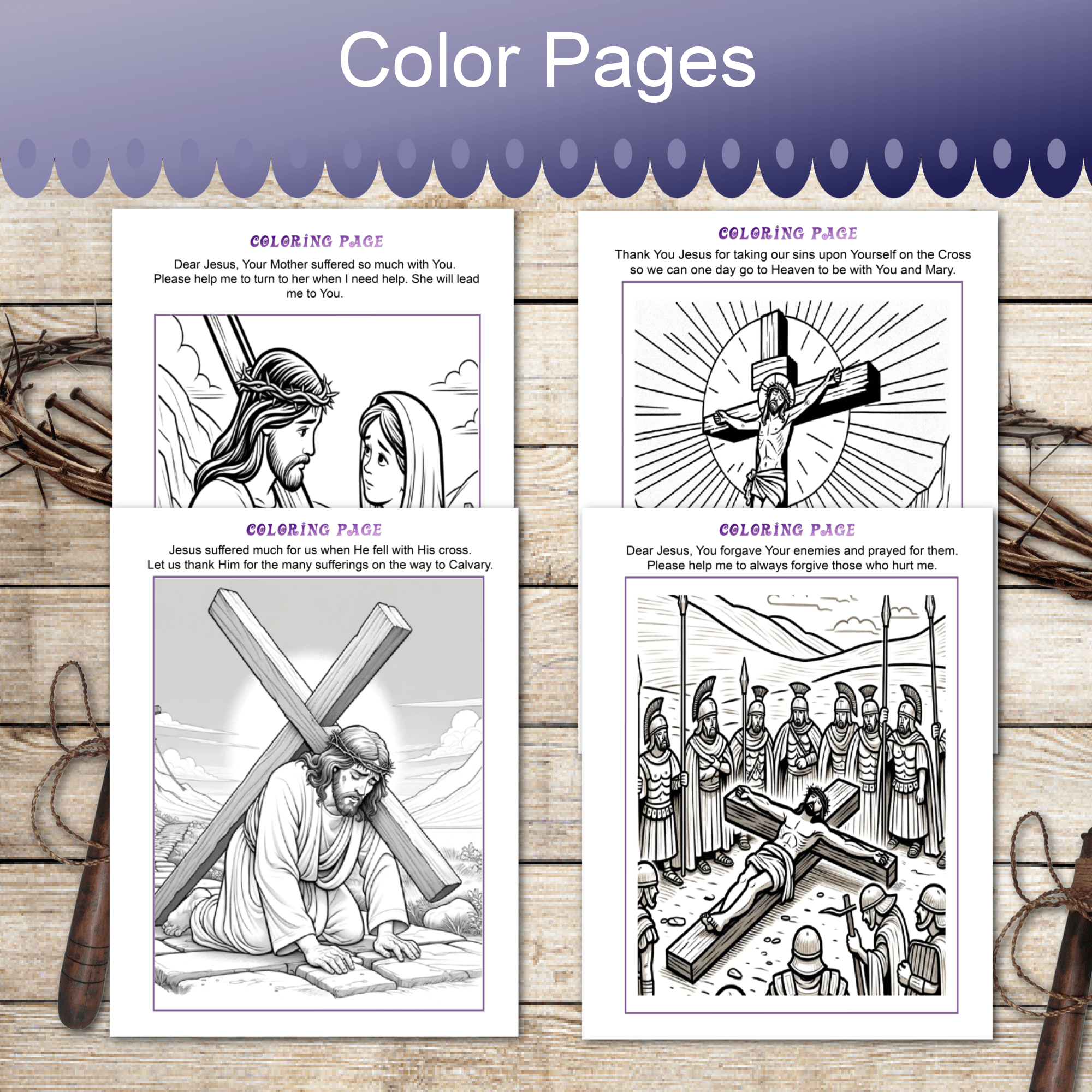
A Bundle of Printable Lenten Activities for Your Children ~ A Journey Through Lent for Young Hearts ~ Available here.
This Catholic Activity Bundle is perfect for families who wish to reinforce the lessons of Lent with their children.
There are 32 pages in the form of a size 8.5 by 11 pdf.
This is a digital download.
The learning bundle includes:
Dot-to-dot activities
Writing copy work
Craft activities
Sacrifice Check List
Drawing activities
Shadow Match
Playdough recipe
Playdough mat



A must-read for the married and those considering marriage! This guidebook to finding a happy marriage, keeping a happy marriage, and raising happy children has been out of print for over 50 years…until now! From the master of the spiritual life, Raoul Plus, S.J., it contains loads of practical and spiritual advice on family life. Have you been looking for a handbook on marriage and raising children that is based on truth? You’ve found it!


The saints assure us that simplicity is the virtue most likely to draw us closer to God and make us more like Him.
No wonder Jesus praised the little children and the pure of heart! In them, He recognized the goodness that arises from an untroubled simplicity of life, a simplicity which in the saints is completely focused on its true center, God.
That’s easy to know, simple to say, but hard to achieve.
For our lives are complicated and our personalities too. (We even make our prayers and devotions more complicated than they need be!)
In these pages, Fr. Raoul Plus provides a remedy for the even the most tangled lives.

This post contains affiliate links. Thank you for your support.






I might have missed it, but what age range is the Lenten activities for children?
Thank you!
I am thinking six years old to 10 years old. But I would look at the actual printables and see what you think…