

Helps to Happiness by Father John Carr, C.SS.R.
WHAT’S THE CROSS?
You know what is meant by the Cross, I suppose? Don’t I! Who doesn’t? When asked that question a certain holy man just crossed his two fingers and said nothing. He had said enough. The Cross is anything that “crosses” us. Crosses are legion in their shapes and sizes. They may be big or small, light or heavy; physical, mental or moral; they may come from within or from without, from friend or foe; they may be personal, or shared with others.
The list is long and old. Fat volumes have been written on this subject. Allow me just a few words. They may be helpful.
One basic fact about the cross is that there is no escaping it. Poor comfort that, you say. Better than you think. In spite of crushing personal experience, the inevitability of the cross is what we find it hard to realize. In theory we believe it; in practice we fight against the cross and resent its presence as something that should not be there, as an intruder on our normal life.
We chafe under it and fret and fume trying to drive the intruder out. We only make the unwelcome presence more pronounced. Dragging it grumblingly after us instead of shouldering it with resignation only adds to its weight.
In trying to shake it from our shoulders we but make them all the sorer. In one shape or another the cross will follow us from our cradle to our grave, and we can no more rid ourselves of its shadow than we can of our own.
We are fallen children of fallen parents, and earth is not meant to be heaven. To take our daily crosses reasonably, then, and settle down patiently to a state of things we cannot change must help. We shall else have two crosses for everyone. Now this could be mere stoicism but for another truth—and a most comforting truth it is.
Every cross—big or little—comes to us directly or indirectly from the hands of God. A platitude if you like, but it is the objects nearest to us we often overlook and it is the platitudes we are in danger of forgetting.
One dictionary defines “chance” as an “undesigned occurrence”; but now, as far as the “Designer Infinite” is concerned, there is no such thing as chance. Nothing happens to you or me that has not been foreseen and at least allowed for our true and ultimate good by an all-wise and merciful God.
It has not come upon us in any blind way, but as part of a design. Oh, if we could but read this into our daily crosses! They would lose much of their weight and we should begin to understand the often puzzling utterances of the Saints. They were just facing facts.
Now God is not cruel. He does not send crosses merely to torture us, and the patient bearing of the daily cross will mean much. Take our past. Though the guilt of our sins is taken away by contrition and the sacrament of Penance, yet what is called the debt of temporal punishment due to sin remains.
This is often enormous, and the last farthing of it must be paid in this world or the next. Now we have but too good reasons for believing that there is no comparison between penance in this world and penance hereafter, and so for many of us the prospect in the next world—even though eventually we reach heaven—may be appalling.
If we are wise, we shall have an eye to business. By the patient bearing of the daily cross we can expiate our sins even here below. To put things commercially—we have a grand chance of paying our bills in a comparatively easy way.
A saint who knew much and wrote much about this matter has written: “He who purges away his faults in this life is able with a penny to pay a debt of a thousand pounds, while he who waits for his purgatory must make up his mind to pay the thousand pounds instead of the penny.” We often smile at the penances of the saints, but it is we who are the fools. The saints laugh last—and best.
Before the next world comes at all, the cross properly borne brings blessings in disguise. No cross leaves us as it finds us. We are the better or the worse of it. It drives us from God or draws us to Him.
A cross well borne has been the turning-point in many a career. It can be a blow severing us from the clutches of a dangerous world; and more than one saint owes his sanctity to such a blow. The cross is an operation performed on our soul by the divine Surgeon. We don’t like operations, but we accept them for our good. We thank the surgeon if he succeeds, and pay him even though he fails. Our soul is in constant need of operations.
A malignant growth – pride, for instance, is eating into our spiritual life. The knife is the only thing: the knife is the cross, and the surgeon is God. If we are wise, we shall let Him have His way. Since there is no anesthetic for such operations – unless indeed it be the love of God- we can interfere with Him by our petulance and our grumbling.
Long ago before dentists became the deft and gentle fraternity we know today, we may remember catching their hand and not giving them free play. We but prolong the agony. Trying to shake off the cross is like clutching at the surgeon’s hand.
Then there is heaven. The cross well carried will mean heaven and will have much to do with our place there. Saint Paul scorns to compare our sufferings on earth with their eternal reward.
The fact that the worst cross passes and that heaven endures rules out all comparison and silences discussion. In heaven we shall see the why and the wherefore of every cross. We shall see how it fitted into God’s design for our happiness and eternity.

Take a piece of embroidery look at the back of it: a meaningless and unlovely crisscross of stitches. Turn it round and you see the beauty and order of the whole. Here below we are looking at the back of the embroidery of our life. In heaven we shall see the design.


The Scourging
“Pilate scourged Jesus.”
Pilate was disturbed by the meek majesty of his prisoner. He turned abruptly and disappeared into his palace, then had Jesus brought before him – to remind Christ, that He was only a prisoner, nothing more.
“What is your crime?” asked Pilate, hiding his interest beneath the mask of official boredom.
Jesus replied, “My kingdom is not of this world.”
That was indeed his crime in the eyes of his accusers; their kingdom was very much of this world.
Pilate knew that Jesus was no criminal; but Pilate was a worldling, like the Pharisees. So he sent Jesus to be scourged.
God so loved the world as to die for it. Pilate so loved the world as to crucify Christ.
Do I love the world as Christ did – or as Pilate loved it?

Sign up for the Giveaway by following this link!


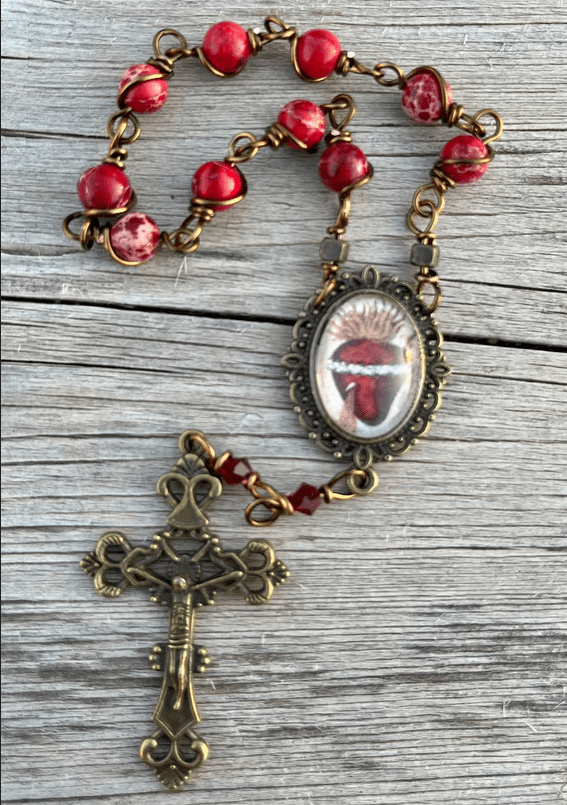
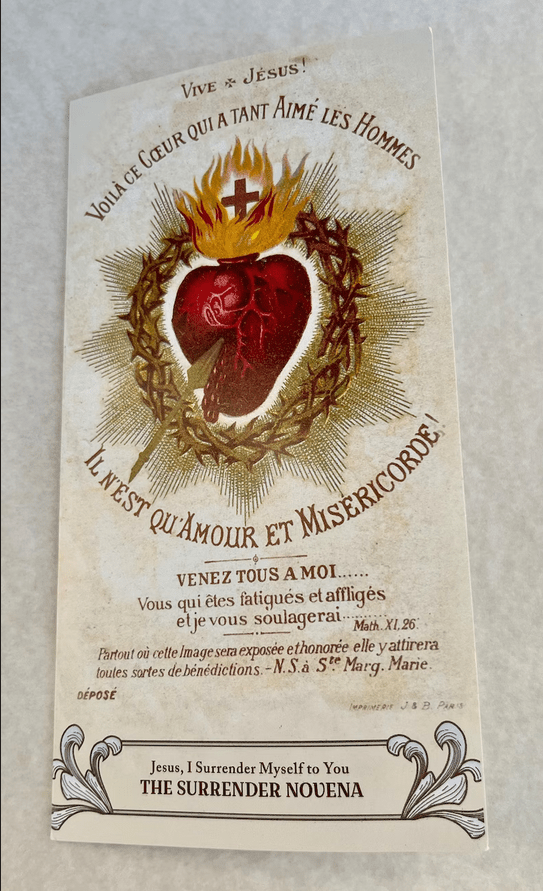
🌺🌺Surrender Novena Prayer Card and Wire Wrapped Chaplet🌺🌺
Available here.
This chaplet is designed to be prayed with the Surrender Novena, which was given to Servant of God, Fr. Don Dolindo Ruotolo.
Each link is handmade and wrapped around itself to ensure quality.
SURRENDER TO THE WILL OF GOD ~ “Jesus, You take over!”
Prayer by Father Dolindo Ruotolo 1882-1970 – Servant of God, Man Who Padre Pio Called a Saint!
Great prayer against worry, fear, anxiety, depression and stress!
Many miracles have been obtained through this novena.


Anna’s Blossoms of Joy~Catholic Hearth Story! Catholic Children’s Easter/Spring Book Set in Poetic Rhyme~Beautiful Hand-Drawn Illustrations ~ Available here.


Douay-Rheims Bible Large Print Edition ~ Available here.
The Large Print Douay-Rheims translation of the Holy Bible is the traditional English translation of the Bible for Catholics. Let our high-quality, ultra-soft, leatherette version of the Douay-Rheims Bible nourish your soul and adorn your family’s mantle and bookshelves!
Its beautiful binding, embossing, gold foiling, and stunning details make this copy the only version of the Bible you will ever need to own. Faithfully rendering the Latin Vulgate, the version of Scripture used traditionally in the Liturgy and approved by the Council of Trent, the Douay-Rheims translation has historically been the most important English translation of the Bible.
Features Include:
- Large Print with the Words of Christ in red
- New Testament maps
- Illustrations depicting the life of Christ
- A historical and chronological index
- Family record pages
- A historical and chronological index
- Illustrations depicting the life of Christ
- New Testament maps


Poems Every Child Should Know ~ Available here.
Poetry is meant for everyone.
For you. For your child. But where to start?
Poems Every Child Should Know is here to help.
Selected and accompanied by commentary from bestselling author and literature professor Joseph Pearce, this exciting collection of verse contains classic poems that every child should know to begin a poetic ascent towards God. Not only that, but these poems are chosen so as to help all “become as little children,” and are ones everyone should know, regardless of age. These timeless treasures form a foundation upon which to build poetic knowledge and to see the world through the eyes of a poet, the way God intended it.
Culled from the rich history of English poetry, these gems of the English language’s inheritance are meant to enrich our children’s cultural treasure chest. Verse, like virtue, is often most beautiful when it is most simple. A good beginning makes a good end all the more likely, so immersing children in beautiful words—words which so powerfully and continually shape our world, our thoughts, our prayers—and teaching them to take a minute and stop to observe a beautiful sentence is of the utmost importance. Appreciating beauty in even the most ordinary of life’s moments is a lesson that will prepare their minds to receive Truth, Beauty, and Goodness Himself.
Throughout the book, readers will find “things to think about,” inviting them to engage more deeply with individual poems. These should be seen as an invitation to an adventure into unknown territory, an opportunity to go further up and further in. Be fearless, be adventurous, and enjoy this journey into the realm of the good, the true, and the beautiful of our English language.

This post contains affiliate links. Thank you for your support.






A blest day to you.
An exquisite piece in its simple, straight forward explanation to the soul! Thank you! I love the embroidery analogy. I had heard that said using a tapestry as an example, many, many years ago….I often tell my friends and children that analogy. But embroidery in our day and age makes much more sense than tapestry! 🙂 I have found much comfort in imagining my tapestry/embroidery being worked away at thus far in my life, as the inexplicable this side of Heaven continues and my soul is often tempted to rankle instead of accept. Thank you for this encouraging piece!
Thank you for sharing your thoughts! ☺️
Beautiful as always, God bless!