

PLAY
God and nature put into youngsters the love for play. That love exists, as we clearly understand, not merely for the sake of the fun they can get out of it but because exercise and games are the most effective ways to develop muscles and coordination and the skilled use of hands and feet.
Nature sees to it that the child does not walk if he can possibly run; nature is driving him to the building up of sinew. No child can resist the lure of a ball or a hoop or a chance to yell at the top of his lungs—with important results to arms and legs and lungs.
Even the natural instinct to play can be wisely guided and directed by the parents. Suppose they provide a sandbox for the little youngsters; this serves not only to keep the children quiet and content but actually to stimulate the creative, constructive impulse instinctive in all of us.
As for gifts they can present the youngsters with sets that they use for building, from building blocks all the way up to the complicated steel construction sets. Thus the youngsters gain a real increase in skill with their hands and brains.
DANCING AND GAMES
I shall refer to this later on, but the first natural dancing partners of the children are the parents. It’s delightful to see a father dancing with his little girl or a mother encouraging her shy young son to take his first dancing steps.
While games among the children themselves are natural enough, children’s games in which the parents take part will stimulate even further the wholesome desire for play.
No other game is so thrilling to children as one in which adults have a place. If dad takes his turn at bat, the sand-lot game takes on new zest.
If mother comes out and cries, “Give me one of those rackets,” all the children on the tennis court are instantly keyed to a new pitch of interest and to a new intensity of determination.
BODY FOR THE SOUL
In all this talk of the development of the body—whether through food, cleanliness, exercise, or play—we are thinking of the body and the soul, those partners which together make the complete and adequate human being.
The horrible degradation of human beings who see in themselves only an animal body has led to a cult of bodies, an ostentation about big muscles or the smooth lines of a beautiful figure, an appreciation like that accorded the strutting of a lion or the parading of a peacock.
Children should early be taught that the body is secondary in importance to the soul and that the health of the body is important in order that the soul may function unimpeded. A strong, vigorous, well-trained body can be a powerful asset. It may mean more calm of mind, more opportunity for the enjoyment of life’s richness. It can never be man’s prime concern.
So the game is for the fun one gets out of it, for the delight of companionship, and for the development of bodily muscles and skill and the display of camaraderie, charity, good sportsmanship.
The matter of winning is entirely of secondary importance. Conceit about one’s muscles or beauty or ability to bat a ball is petty and small and a little below the dignity of a human being.
THE CHILD’S MIND
When we come to the parents’ care of the child’s mind, we are of course thinking of the days that precede formal education. For the mind, like the body, begins to develop at birth. And in the case of the mind, as of the body, the first few years are of really disproportional importance.
DON’T’S FOR THE MIND
First we can start with the things that parents should not put into their children’s minds. Actually in many cases parents pour—quite unconsciously but with painfully lasting results—into the minds and souls of their children weaknesses and limitations of which they themselves should be ashamed.
NO FEARS
Rule one is quite simple: Never give a child a fear.
I suppose every man or woman in the world has some sort of personal fear—whether of heights or the dark or cats or ghosts or the policeman or crowds or fire or the dead.
Parents transfer these fears of theirs, sometimes deliberately and sometimes without thinking, to their children. It’s too bad that a child should have to start off in life with an equipment of dreads and fears and instinctive terrors.
How parents themselves act toward their fears, quite as much as what they say about them, leaves a lasting impression on youngsters. If a mother shudders every time a cat comes near her, she is likely to find her little daughter shuddering at the sight of a kitten.
If a father talks in all solemnity of the ghosts that lurk in dark corridors, even if he may think this only a particularly fruity joke, his boy may dread dark corridors for many a long year.
So out of love of their children as well as out of a desire for their personal happiness parents should try to get rid of their own fears. Where the children are concerned, they should with the most conscious effort try to hide the things of which they are afraid.
I have known boys, well developed and otherwise normal, to scream in terror when a dog brushed against them. Their parents were afraid of dogs. I’ve heard from girls the ancient legend of the woman who wakes and finds a cat resting on her chest; and as she cries out in fright, the cat buries its claws in the woman’s throat. The story is one of the oldest of old wives’ tales. It has served nonetheless to place those girls eternally in terror of cats.
BOGEYMEN
Parents will deliberately go about frightening children in order to make them behave. They may get a temporary result, a sort of cowed silence; but the lasting effects are pretty bad.
“If you don’t stop crying, the bogeyman will get you,” mothers have said, probably from the dawn of history. Inevitably with every age that bogeyman has undergone transmutations.
Over a century ago mothers frightened their children with the threat of Napoleon’s getting them, as they probably frighten children today with the bogey Hitler. Anything will serve: ghosts, devils, “a horrible man who jumps out on bad little children,” even God as a terrible threat.
Yes; the father himself becomes a bogeyman. “You just wait until your father comes home and I tell him how you’ve been behaving. He’ll fix you.”
So when dad arrives and cheerily calls to his children, he sees them scurry away to hide in a closet. He, poor chap, wonders why his children act afraid of him, especially since it is all he can do to force himself to speak sternly to them.
DEVELOPED FEARS
Parents develop in their children lifelong dreads. “Stop crying, or I’ll go off and turn out the light and leave you in the dark.” The mother will hit that word dark as if it were an awful, palpable, living monster waiting to leap out of the corridor and suffocate the child.
“There are terrible giants who eat up little children who are bad like you,” the child is solemnly warned, and he has something else to be afraid of.
Or in their casual conversation parents admit that they are terribly afraid of being burned alive, of being buried alive, of being drowned, of falling off high buildings—and the children grow up afraid of fire, of even a closed door, of any approach to a body of water, of any height above five feet.
FLIGHT FROM FEAR
Sometimes it will happen that one brave parent and one naturally timid one will result in the death of a great many fears.
There is my own case. I had a father who was afraid of nothing and a mother who was timid about almost everything. My father bolstered up my courage in a dozen ways. He loved dogs and encouraged me to pat any strange dog I met—while my mother stood by, momentarily expecting me to lose a hand or an ear.
He always pretended it was fun to hunt burglars, and he made a great show of keeping his revolver under a carelessly tossed sock beside his bed—while any slightest night noise about the house roused my mother to a sleepless vigil.
As a result of this joint training I was afraid of almost nothing. When mother and I returned in the late afternoon, she inserted the key in the lock, opened the door cautiously, and then sent me on ahead.
After I had joyfully explored the house, looking with genuine hope for a burglar or a ghost, I called downstairs that all was clear; then and only then did she enter the house.
There are enough real things in the world to be afraid of without parents’ bequeathing to a child a heritage of their fears.
A wise respect for buzz saws, the devil, speed in any form, the law, and God is all part of the beginning of wisdom. None of these has anything to do with the unreasonable terrors that can twist and distort the soul of a child.


“We must live in the present moment. This is the only moment within our hands, the only one that can make us happy. The past exists no more; let us leave it to the Divine Mercy. And, though it does not yet exist, let us entrust the future to God’s loving Providence and live happily in the present.” -Fr. Narciso Irala, S.J., Achieving Peace of Heart


Did you know that even the littlest things we do can become beautiful gifts of love to Jesus? Join Mrs. V for three charming Catholic stories from A Treasury of Catechism Stories by Fr. Lovasik! 🌷 St. Bonaventure and St. Thomas Aquinas – Anyone, even a little child, can love God with all his heart! 🌷 St. Charles Borromeo – Even our playtime can be offered to God! 🌷 The Old Wood Carver – A touching reminder that God sees our good deeds, even when no one else notices. Gather the children, settle into a cozy spot, and enjoy these sweet stories about loving God in the little things!

Christmas True Love Apron! Feminine and Beautiful! ~ Available here.
⋆❆˚。₊⊹❅⋆ Fully Lined, Quality Material, Made with Care and Detail. ⋆❆˚。₊⊹❅⋆

A little encouragement for the Catholic wife, mother, and young lady! 🌷 Filled with timeless wisdom, inspiration, and gentle reminders to live our beautiful Catholic Faith in the everyday moments of life.
Special Bundle of 5 Maglets! The Catholic Wife’s Maglet, The Catholic Mother’s Maglet, The Catholic Young Lady’s Maglet, Timeless Values, and Grace-Filled Home.
💕
~ Available here.

Get ready! Christmas St. Andrew Novena Wire-Wrapped Chaplet with Prayer Card. This is a Very Powerful Novena! Let this chaplet help keep you on track as you say the “Hail and Blessed” Prayer throughout the Advent Season! Available here.

˚. ⋆ Lovely Christmas Gift! ˚.⋆
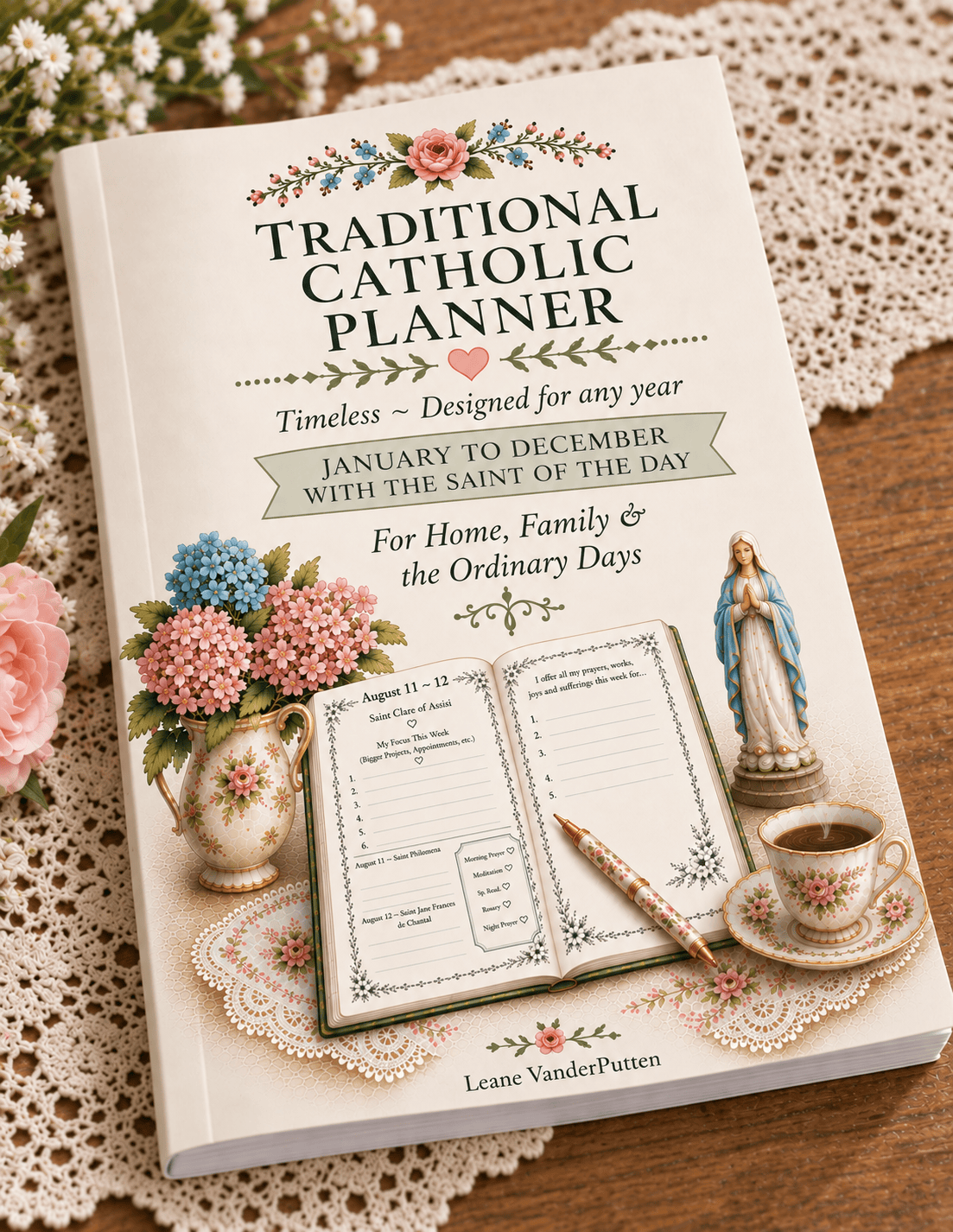
As this planner has been selling quickly it is on a bit of a backorder, so get your order in now for Christmas!
 My new Traditional Catholic Planner is available here.

 Traditional Catholic Planner — Use Any Year
 A full year of planning
 Saint of the Day & Catholic inspiration
 Created with Catholic homemakers and families in mind


Christ in the Home ~ Available here.
This guidebook to finding a happy marriage, keeping a happy marriage, and raising happy children has been out of print for over 50 years…until now! From the master of the spiritual life, Raoul Plus, S.J., it contains loads of practical and spiritual advice on family life. Have you been looking for a handbook on marriage and raising children that is based on truth? You’ve found it!

Holy Simplicity ~ Available here.
The saints assure us that simplicity is the virtue most likely to draw us closer to God and make us more like Him.
No wonder Jesus praised the little children and the pure of heart! In them, He recognized the goodness that arises from an untroubled simplicity of life, a simplicity which in the saints is completely focused on its true center, God.
That’s easy to know, simple to say, but hard to achieve.
For our lives are complicated and our personalities too. (We even make our prayers and devotions more complicated than they need be!)
In these pages, Fr. Raoul Plus provides a remedy for the even the most tangled lives.
Sins of the Tongue or Jealousy in Woman’s Life
by Monseigneur Landriot, Archbishop of Rheims,
Translated from the French by Helena Lyons
“This book consists of fifteen discourses (four on Sins of the Tongue, three on Envy and Jealousy, two on Rash Judgments, two on Christian Patience, and four on Grace) that were originally talks given to laywomen of his diocese in the late 19th century. At the beginning the good Archbishop says I propose, my children, to give you some instructions on the tongue, and the faults which it causes us to commit. I shall commence today by speaking of the power and beauty of that organ, of the noble use which ought to be made of it, and of the many advantages we may derive from it. There is precious little teaching on the topics covered in these instructions which is accessible to the average man and woman of today.” Loreto Publications

This post contains affiliate links. Thank you for your support.






Recent Comments